The most important chemicals to avoid in perfume are substances prohibited by the law of the target market, materials banned under the current IFRA Standards, and undeclared contaminants or impurities that make the finished product unsafe. That answer is more useful than a viral “toxic ingredients” list. A material may be forbidden, restricted to a specific concentration, required on the label, or unsuitable only for a person with a diagnosed allergy. Those are four different situations.
BWX supplies high-quality synthetic fragrance ingredients for fine fragrance and daily personal care items. They know that real safety always begins with correct identity. It starts with controlled purity and making sure the ingredient is used in the right intended product category. Please remember, the word “synthetic” does not automatically mean harmful. In the exact same way, the word “natural” does not automatically mean gentle. Both nice natural extracts and laboratory-made aroma chemicals can hide strong allergens or restricted constituents.
A Better Way to Read a Perfume Ingredient List
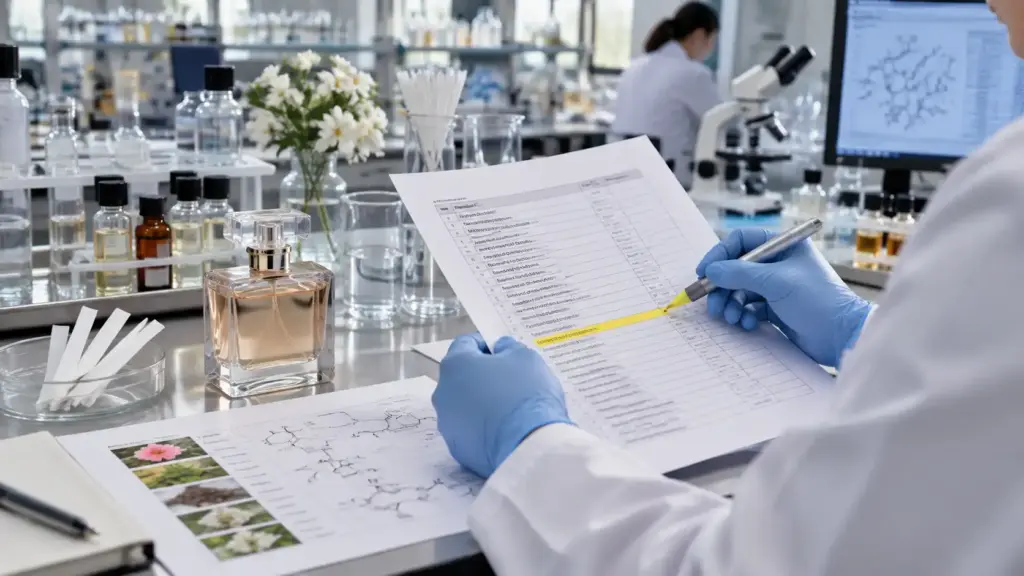
Perfume safety cannot be judged by counting long chemical names. Water, ethanol, essential-oil constituents, fixatives, and aroma molecules are all chemicals. The practical question is whether each material is permitted for the intended market and use level, supported by suitable safety information, and accurately represented in the finished-product assessment.
Use this framework:
| Ingredient status | What it means | Appropriate action |
| Prohibited | The material cannot be intentionally used in the relevant product or market | Exclude it from the formula |
| Restricted | The material has a maximum level, product-category limit, purity rule, or other condition | Calculate exposure and comply with the exact restriction |
| Labelled allergen | The material may be permitted but must be declared above a threshold | Label correctly; sensitized users may need to avoid it |
| Contaminant or impurity | It is not an intended fragrance note and may enter through raw materials or processing | Set specifications, test where necessary, and investigate detections |
| Buyer preference | A brand or retailer excludes a permitted substance for positioning or customer demand | Treat it as a commercial specification, not a universal toxicology rule |
Chemicals That Should Not Be Used in a Compliant Perfume
Butylphenyl Methylpropional (Lilial or BMHCA)
Butylphenyl Methylpropional, commonly called Lilial or BMHCA, should be absent from perfumes and other cosmetics sold in the European Union. It was added to the EU prohibited-substances list and the prohibition has applied since March 1, 2022. Older formulas, inherited fragrance oils, and poorly controlled stock deserve particular attention because the material was once widely used for a floral, lily-of-the-valley effect.
For an EU-bound product, confirm the formula status and current regulatory declaration. Use targeted analytical testing when the supply chain or risk assessment warrants it.
HICC, Atranol, and Chloroatranol
Hydroxyisohexyl 3-Cyclohexene Carboxaldehyde (HICC, often known by the former trade name Lyral), atranol, and chloroatranol are prohibited in EU cosmetic products. These substances were associated with contact allergy concerns. Atranol and chloroatranol may also occur as constituents of oakmoss- and treemoss-derived materials, so reviewing a natural extract requires more than checking whether the formulator added either substance directly.
This is a good example of why “natural perfume” is not a safety category. Botanical origin does not remove the need for compositional data, purification controls, or regulatory review.
Musk Ambrette
Musk ambrette (CAS 83-66-9) should not be used as a fragrance ingredient. The current IFRA Standard classifies it as prohibited because of photosensitization and neurotoxicity concerns, and it appears on the EU list of substances prohibited in cosmetics. It should not be treated as an acceptable perfume fixative simply because it appears in historical formulas or remains commercially available for other discussions.
Any musk material must be identified by its exact chemical name and CAS number. “Synthetic musk” describes a broad family, not one substance, and the regulatory status differs among individual materials.
Restricted Ingredients Are Not Automatically Banned
Many online articles place every fragrance allergen in an “avoid at all costs” list. Limonene, linalool, citral, eugenol, coumarin, geraniol, citronellol, and benzyl benzoate can occur in natural extracts or be added individually. Their presence does not by itself prove that a perfume is unsafe.
The relevant questions are concentration, product category, exposure route, applicable IFRA Standard, destination-market law, and the needs of sensitized consumers. Teams developing perfume and daily chemical fragrance applications should calculate restricted constituents from every source, including essential oils and other natural complex substances.
The EU expanded individual fragrance-allergen labelling through Regulation (EU) 2023/1545. Since July 31, 2026, non-compliant new products may no longer be placed on the EU market; products placed there earlier have a transition period until July 31, 2028. An allergen on the label does not mean the product is generally unsafe. It helps a sensitized person avoid a specific trigger.
Phototoxic Citrus Constituents
Some expressed citrus oils contain furocoumarins that can cause phototoxic reactions when a leave-on product is applied to skin exposed to sunlight. This does not mean every citrus note must be removed. The formulator may select a treated grade, control the relevant constituents, or keep the finished-product level within the applicable restriction.
The oil name, extraction method, botanical source, and constituent profile matter. “Bergamot oil” without grade information is not a complete specification.
What About Phthalates, Parabens, and Formaldehyde?
These terms often appear together in consumer articles, but they should not be handled as if they were one fragrance-ingredient class.
Diethyl phthalate (DEP) has been used as a solvent and fixative in fragrance preparations. The U.S. FDA states that DEP does not pose known human-health risks as currently used in cosmetics and fragrances. A brand may still request a phthalate-free perfume for market positioning or retailer compliance. If so, the requirement should name the excluded substances and define how the supplier will confirm compliance. Saying “all phthalates are toxic” is not an accurate substitute for a specification.
Parabens are preservatives, not a standard category of perfume aroma chemicals. Formaldehyde and formaldehyde-releasing preservatives are also separate formulation issues. Their relevance depends on the finished product, preservation system, raw-material impurities, packaging, and jurisdiction. An alcohol-based fine fragrance and a fragranced water-based body product do not have the same microbiological or preservative needs.
The same caution applies to “aldehyde-free” claims. Aldehydes include many unrelated molecules, several of which are valued odorants. Evaluate the named substance, not the family label.
Contaminants and Poorly Controlled Impurities
A compliant ingredient can become a problem when its identity, purity, or residual profile is not controlled. Methanol, benzene, unsuitable residual solvents, heavy metals, or unexpected reaction by-products are not desirable perfume notes. Whether testing is needed depends on the material, manufacturing route, supplier history, and risk assessment.
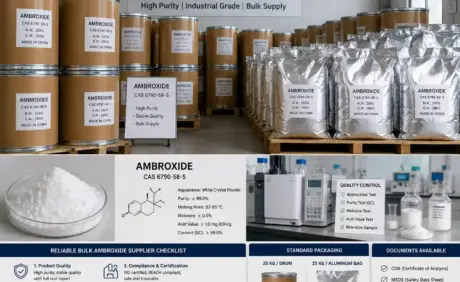
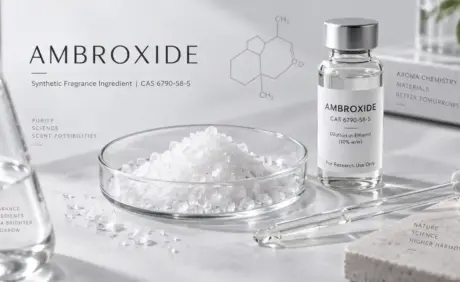
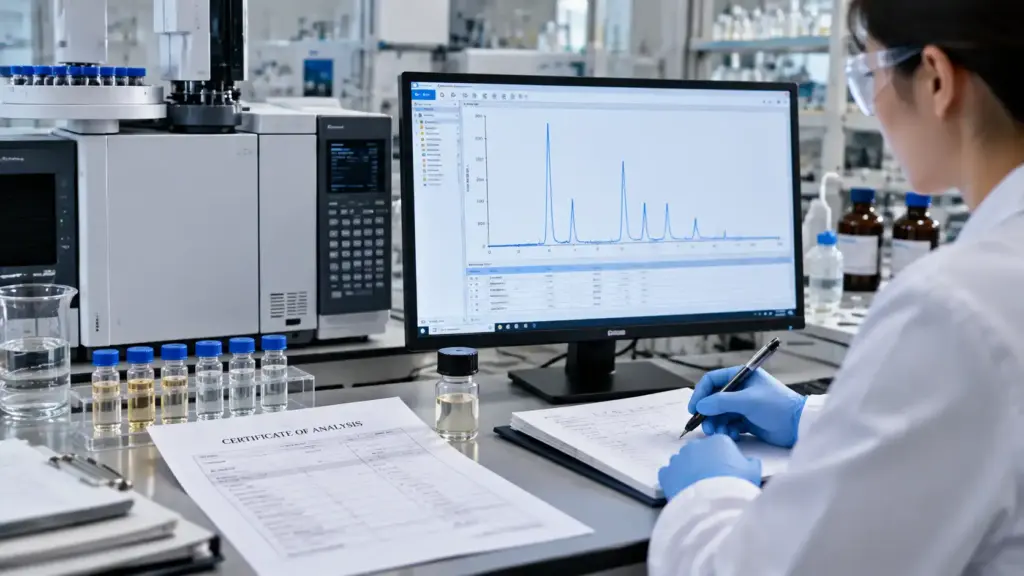
Odor quality also matters. Trace isomers or residual solvents may create harsh or off-profile notes even when the headline assay looks acceptable. For an aroma material such as Ambroxide for amber-woody fragrance formulations, procurement should match the product name and CAS number across the specification, sample label, certificate of analysis, and commercial batch. Chromatographic data can help investigate identity, purity, and unexpected peaks when routine acceptance checks are not enough.
A Practical Screening Checklist for Perfume Manufacturers
Before approving a perfume compound or aroma chemical, record the target market and finished-product category. Then complete these checks:
- Confirm the exact chemical identity, CAS number, trade name, and function of each critical raw material.
- Screen the formula against the current prohibited and restricted lists for every destination market.
- Apply the current IFRA Standards to the correct finished-product category and use level.
- Calculate restricted constituents contributed by natural extracts, not only materials added individually.
- Review the SDS, TDS, current batch COA, allergen declaration, and applicable IFRA documentation.
- Define impurity and residual-solvent limits that reflect the production route and risk.
- Check whether colorants are permitted for the intended cosmetic use and market.
- Test the fragrance in the actual base; neat odor evaluation cannot establish finished-product safety or compatibility.
- Retain the approved sample and connect it to the COA, lot number, packing label, and shipment record.
- Reassess the formula when a supplier, manufacturing site, process, specification, or regulation changes.
BWX provides technical documentation and application support for aroma chemicals, including batch and product information used during qualification. The finished-product manufacturer remains responsible for the final safety assessment, formula compliance, labelling, and market release.
How Consumers Can Reduce Avoidable Risk
Buy from a traceable brand, follow the directions, and avoid products with missing or suspicious labels. Anyone with a diagnosed fragrance allergy should look for the specific allergen identified by a clinician instead of relying on “clean,” “natural,” or “hypoallergenic.” In the United States, those terms do not define allergen risk.
Stop using a perfume if it repeatedly causes redness, itching, swelling, breathing discomfort, or another concerning reaction. Seek medical advice for persistent or severe symptoms. Reducing exposure cannot make a prohibited or unsuitable formula acceptable.
FAQ
Are synthetic fragrance ingredients more dangerous than natural ones?
No, they are not. Safety truly depends on the specific identity, the dose, the exact purity, the exposure, and the intended use of each material. Natural extracts can easily contain dangerous allergens or bad phototoxic constituents. Meanwhile, well-characterized synthetic materials can offer very clean, consistent composition.
Should perfume contain phthalates?
That answer depends on the exact named phthalate, the target market, and the strict buyer specification. The FDA does not identify a known human-health risk from DEP as currently used in cosmetics and fragrances. However, smart brands may still choose a strictly defined phthalate-free standard to make customers happy.
Is limonene a toxic perfume ingredient?
No. Limonene is a normal fragrance substance. It is a labelled allergen in some markets, but definitely not a universally prohibited toxic ingredient. Its exact concentration, oxidation state, product type, and the user’s personal sensitization all matter greatly.
Does “fragrance-free” guarantee no allergic reaction?
No, it does not. A fragrance-free product can easily contain many other potential allergens or itchy irritants. Also, U.S. marketing terms such as “hypoallergenic” do not guarantee that a sensitive person will not react badly.
What documents should a perfume manufacturer request from an aroma chemical supplier?
Start by asking for the current specification, the SDS, the TDS, and the current batch COA. Depending on the material and your target market, you should also request a few more things. Ask for an allergen declaration, official IFRA-related documentation, scientific chromatographic data, real origin or process information, and a solid change-notification commitment.