Ambroxan on skin is best understood as a dry amber-woody base material rather than a single, predictable smell. It can give a perfume a clean mineral warmth, extend the impression of a drydown, and connect fresh, floral, woody, or musky notes. The result depends on the exact material identity, dosage, solvent, finished formula, skin chemistry, and the way the product is tested. “Long-lasting” is therefore a formulation outcome, not a promise that the neat ingredient will smell strong for a fixed number of hours.
For product developers, the practical questions are practical: What does it smell like, how should persistence be tested, and what checks are needed before a leave-on product is released? The guidance below combines sensory and sourcing considerations.
What Is Ambroxan?
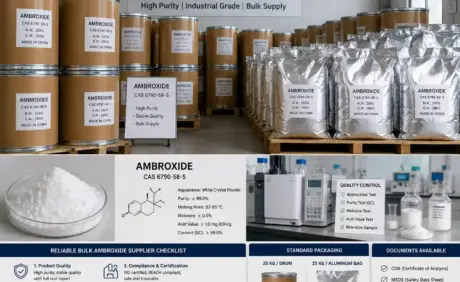
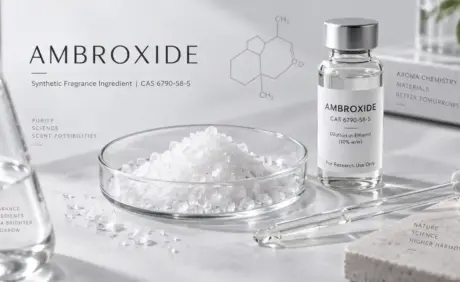
Ambroxan is commonly used in fragrance discussions for ambroxide-type amber materials. Ambroxide (Ambroxane) is listed as CAS 6790-58-5, molecular formula C16H28O, molecular weight 236.39, a white crystalline solid, melting point 74–77 °C, and GC purity of at least 99.0%. The same entry describes an amber, woody, dry profile with possible pine, cypress, green, and tea nuances.
The name can be confusing because similar amber materials are sold under different trade names. Cetalox and Ambrocenide (also called Amberoxole in the supplied material) are separate entries with different CAS numbers and sensory profiles. Before substitution, check the current specification, CAS number, physical form, concentration, and certificate of analysis. A trade description alone is not enough to predict how a batch will perform on skin.
As a base-note material, Ambroxan can add a smooth radiance around more volatile notes. It may make a citrus, marine, floral, or woody accord feel more connected as the top notes fade. At a higher level, the same material can become noticeably dry, linear, or strongly amber-woody. The finished fragrance, not the neat crystal, is the correct object for sensory approval.
How Does Ambroxan Smell on Skin
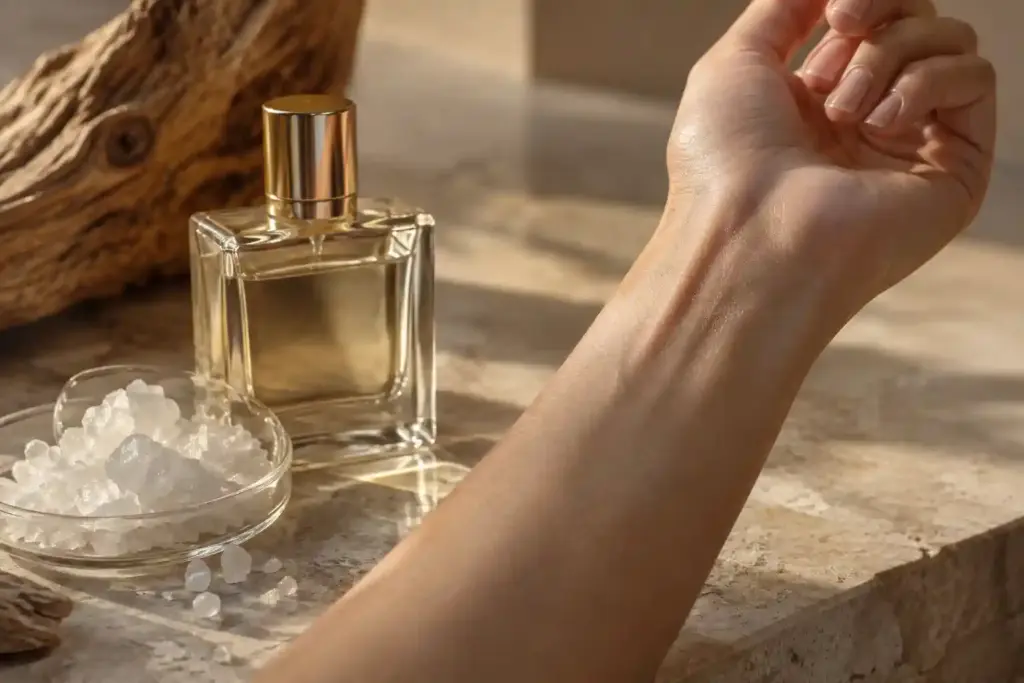
On skin, the opening is usually less about a bright top-note burst and more about structure. Ambroxan can support diffusion and give fresh materials a warmer frame. In a marine or citrus formula it may read as clean, mineral, or lightly salty. In a floral or musk formula it can make the base feel fuller without adding a clearly identifiable “ambergris” note.
During the heart, temperature and natural skin oils can soften the dry woodiness. One wearer may notice a gentle musky warmth; another may perceive dry cedar-like facets or a cool mineral effect. Humidity, application amount, and the surrounding formula can change this balance. A blotter is useful for comparing samples, but it cannot replace a controlled skin trial.
The drydown is where Ambroxan is most often valued. After brighter materials recede, it can leave a persistent amber-woody trace and help a fragrance feel polished. Perception still varies. Some people detect Ambroxan easily; others mainly notice the character of the materials around it. This variation is normal and is one reason a formulator should record both personal perception and an outside observer’s feedback.
How Long Does Ambroxan Last on Skin?
There is no universal number of hours that can be assigned to Ambroxan by itself. Longevity changes with concentration, solvent, dosage, skin condition, humidity, temperature, application area, and the volatility of the other ingredients. Clothing and hair often hold the aroma longer than warm, exposed skin. A wearer can also stop noticing a persistent material because of olfactory fatigue while people nearby can still perceive it.
For a meaningful comparison, evaluate the same finished formula on clean skin and on a blotter. Use the same amount, area, and observation schedule. Record the opening, two-hour, six-hour, and next-morning impressions. An outside observer helps reduce olfactory-fatigue bias; record both intensity and drydown quality.
If the goal is to compare suppliers, use the same dilution and maturation time for every sample. Keep the formula, bottle, and application method constant. Record the batch number so an unexpected odor can be traced back to a sample rather than incorrectly blamed on the whole material category.
Ambroxan on Skin: Safety Considerations
A fragrance ingredient is not the same as a finished cosmetic product. Safety depends on identity, purity, impurities, concentration, route of exposure, product category, and the requirements of the target market. The supplied knowledge base contains detailed hazard information for Ambrocenide, CAS 211299-54-6. Those statements must not automatically be transferred to Ambroxide, CAS 6790-58-5. Always match the SDS, COA, allergen information, and regulatory assessment to the exact CAS number and batch.
Before a formula is applied to skin or released for sale:
- Confirm the exact identity and current SDS; do not rely on a trade name alone.
- Check the intended category and the latest applicable IFRA guidance or local cosmetic rules with a qualified regulatory professional.
- Use an approved concentration range for the finished product, not a neat-material assumption.
- Review impurities, residual solvents, storage history, and any relevant oxidation concerns.
- Patch-test a small amount of the finished formula. Stop if redness, burning, swelling, itching, or persistent discomfort occurs.
- During handling, follow the SDS for gloves, eye protection, ventilation, spill control, and disposal.
A patch test cannot prove that a formula is suitable for every person and does not replace a formal safety assessment. People with fragrance allergy, eczema, or highly reactive skin should seek professional advice before regular use. For environmental handling, follow the current SDS and local disposal rules rather than assuming that a fragrance solid can be washed into a drain.
For practical document questions, review the supplier’s fragrance ingredient sourcing FAQs alongside the current SDS and market rules. An FAQ can orient an initial inquiry, but it does not replace a batch-specific safety or regulatory review.
Formulation and Testing Tips
The supplied product information describes Ambroxide as insoluble in water and soluble in organic solvents such as ethanol. Actual dissolution depends on grade, particle size, temperature, solvent quality, and the rest of the carrier system. When accurate dosing matters, prepare a measured stock solution and allow sufficient maturation time before judging odor or clarity.
During development, compare at least three levels around the intended dosage while keeping every other formula variable constant. Check neat odor, solution clarity, color, crystallization, stability, and the quality of the drydown. A current COA, TDS, SDS, and, where available, a GC or GC-MS result can help connect sensory differences with batch quality. Request current documents for the actual batch instead of relying on an old certificate.

Ambroxan can serve more than fine fragrance. Depending on the finished formula and applicable rules, developers may evaluate it in personal care, home fragrance, fabric care, or other scent-led products. The company’s fragrance applications and formulation directions provide a relevant starting point for mapping the material to an end-use category. Product claims still require review against the final composition and market requirements.
Choosing a Reliable Ambroxan Supplier
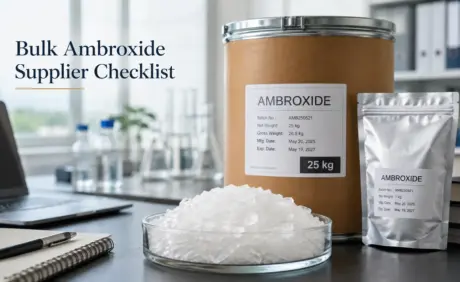
Supplier selection should begin with identity and documentation, then move to sensory performance and logistics. Ask for the exact product name, CAS number, purity method, physical form, packaging, storage conditions, sample size, MOQ, lead time, and export documents. The supplied knowledge base states that fragrance-material documentation can include COA, MSDS/SDS, TDS, flow chart, allergen report, and IFRA documentation according to customer needs. Each document should be checked for the intended market and current batch.
For product discovery, compare the supplier’s Ambroxide fragrance ingredient page with the wider synthetic fragrance ingredients range. This helps prevent accidental substitution between Ambroxide, Cetalox, and Ambrocenide. A sample should be evaluated before a commercial order, and the approved reference should be compared with the first production lot.
When supply continuity matters, discuss packaging, shipment mode, seasonal lead-time risks, and retained samples. The knowledge base describes solid-material packaging as inner PE or aluminum bags inside 25 kg fiber drums, with samples and commercial quantities handled separately. Confirm the final option in the quotation and shipping documents.
For a first inquiry, use the supplier’s technical services and sourcing support to request a sample, current COA, SDS, TDS, and a proposed application level.
FAQ
Q1: Is Ambroxan safe to put directly on skin?
A: Do not apply the neat raw material directly. Use it only in a properly assessed finished formula at a suitable concentration, following the exact SDS and applicable regulations.
Q2: Does Ambroxan smell the same on everyone?
A: No. Skin oils, temperature, humidity, dosage, and the surrounding formula can change both the character and apparent strength.
Q3: Is Ambroxan the same as Cetalox or Ambrocenide?
A: No. They are distinct materials. Confirm the CAS number, specification, physical form, and concentration before substituting one for another.
Q4: What is the best way to test longevity?
A: Use the same finished formula on skin and a blotter, record several time points, and include an outside observer to reduce olfactory-fatigue bias.
Conclusion
Ambroxan on skin is a dry, woody-amber effect shaped by the complete formula. Reliable evaluation requires exact identity control, measured dilution, controlled skin and blotter trials, current batch documentation, and a market-specific safety review. For procurement, request a sample and the relevant technical documents before committing to a larger order. A supplier that can answer identity, quality, application, packaging, and documentation questions clearly is easier to qualify and easier to work with over time.