Biodegradable fragrance chemistry is changing the way aroma chemicals are designed, made, and purchased. For Ambroxide and Cetalox, scent still comes first, but buyers also want to know where the carbon came from, how the material was processed, and what happens after release into the environment.
Those questions need careful wording. Bio-based, green-produced, and biodegradable do not mean the same thing. A renewable feedstock describes origin. Green chemistry concerns process impacts. Biodegradability describes environmental breakdown under defined test conditions. A grade may meet one description without meeting the other two.
BWX supplies synthetic fragrance ingredients for fine fragrance, cosmetics, personal care, and household applications. A sustainability comparison should be grade-specific: identity, odor, purity, process evidence, environmental data, and batch documents must point to the same material.
What Biodegradable Fragrance Chemistry Actually Measures
The word “biodegradable” sounds simple, but a useful claim must name a test method, test material, result, and scope. OECD ready-biodegradability methods measure breakdown under controlled conditions. Data for a capsule shell, carrier, or finished fragrance does not prove that every aroma chemical inside has the same result.
A molecule produced from fermented sugar may use renewable carbon, yet its environmental fate still depends on its structure. Procurement teams should keep four questions separate:
- Is the feedstock renewable, fossil-based, recycled, or mass-balanced?
- Does the manufacturing route reduce steps, solvent use, energy demand, or waste?
- Has the exact commercial grade been tested for ready or inherent biodegradability?
- Does the claim cover the neat ingredient, a dilution, or the finished fragrance?
This separation prevents a sustainability phrase from reaching the product brief before the supporting data reaches quality or regulatory teams.
Why Ambroxide Production Is Changing
Ambrox-type materials were historically produced from sclareol, a diterpene obtained from clary sage. That route replaced dependence on natural ambergris and remains commercially important. Yet “plant-derived” is only the start of the environmental discussion. Extraction, conversion, purification, and solvent recovery all affect the footprint.
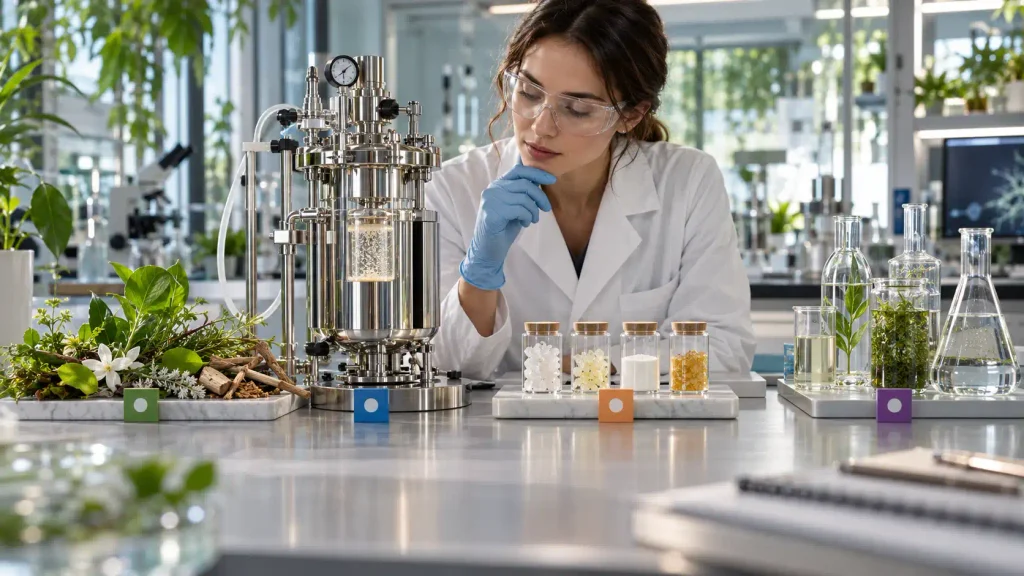
Recent industrial research has opened another path. Fermentation can produce beta-farnesene from sugar; it is then converted to homofarnesol and cyclized with an engineered enzyme. Published work reports better step and atom economy than the traditional sclareol route, with lower waste, solvent consumption, and energy demand. The gain comes from combining renewable feedstock, selective chemistry, biocatalysis, and scalable purification.
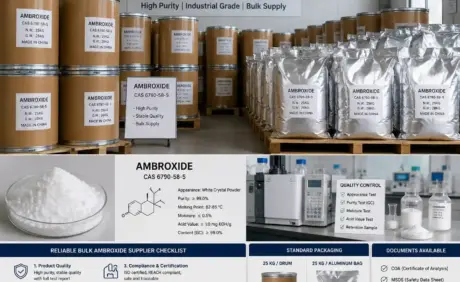
For a buyer, that progress creates a new question: which route made the quoted grade? The Ambroxide offered by BWX is identified as CAS 6790-58-5, formula C16H28O, with a minimum GC purity of 99.0%. These specifications establish identity and quality. A renewable-carbon or reduced-impact claim needs separate, route-specific evidence.
Cetalox Needs the Same Evidence Discipline
Cetalox sits in the same broad ambergris-woody conversation, but its name alone cannot establish feedstock, manufacturing route, carbon footprint, or biodegradation result. BWX identifies Cetalox as CAS 3738-00-9, formula C16H28O, supplied as white to nearly white crystals or powder with a minimum content of 99.0%.
The material is valued for an elegant woody-ambergris profile, diffusion, and substantivity. Those traits do not reveal how a batch was produced. If a quotation describes “eco-friendly Cetalox,” ask what changed: raw material, catalyst, solvent, energy, recovery, packaging, or verified biodegradability. A specific answer can be assessed. A broad label cannot.
Trade names and generic descriptions are often used loosely. Match the commercial name to the CAS number, specification, manufacturer, batch, and environmental statement before approving a finished-product claim.
Where Green Chemistry Can Improve the Process
Renewable and Traceable Feedstocks
Clary sage, fermentation-derived intermediates, and other bio-based precursors can reduce reliance on fossil carbon. Agricultural inputs, fermentation energy, separation, transport, and yield still count. Ask for the feedstock basis and chain-of-custody method instead of assuming that “natural origin” means lower impact.
Selective Catalysis and Fewer Steps
Every extra reaction can add reagents, solvent, heating, and purification. A selective catalyst or enzyme may reduce side products and simplify isolation. Step count is not a complete metric, but fewer high-yielding operations create more room to cut material and energy use.
Solvent, Water, and Energy Management
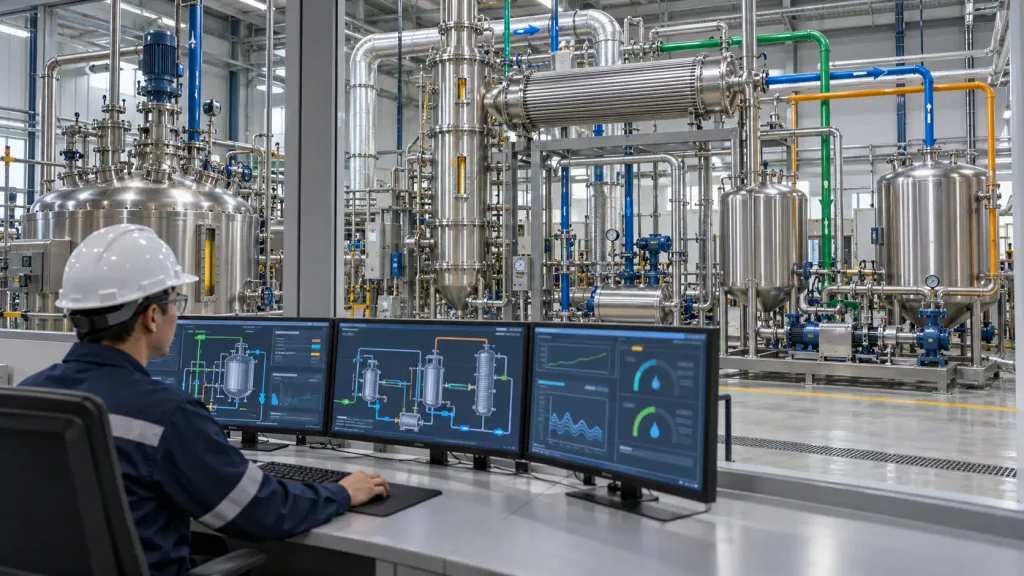
Solvent recovery, exchanges, distillation, water, and drying can matter as much as solvent choice. A closed-loop process that recovers most of its solvent may outperform one that uses a preferred solvent poorly. Ask for measured improvements against a stated baseline.
Yield, Purification, and Waste
High selectivity helps fragrance quality and waste reduction. Trace isomers, residual solvents, and odor-active impurities can alter a refined amber note even when the headline assay looks acceptable. Useful metrics include yield, solvent intensity, E-factor, waste treatment, and off-spec rate.
Packaging and Logistics
Environmental work does not stop at the reactor. Pack size, liners, pallet efficiency, and transport distance affect the delivered footprint. BWX can supply solid aroma chemicals in commercial packs, with the inner bag, outer drum, quantity, and shipping conditions confirmed in the quotation.
Sustainability Cannot Replace Formula Performance
An improved production route has little value if the material fails in the finished product. Ambroxide brings a clear ambergris and dry woody profile with pine, cypress, green, and tea facets. Cetalox leans toward an elegant woody ambergris effect with strong diffusion. Both are water-insoluble solids, so solvent, concentration, temperature, and maturation affect handling.
Test the proposed grade in the actual base. Fine fragrance, body wash, fabric care, candles, and home fragrance expose ingredients to different solvents, surfactants, heat, pH, and packaging. BWX’s overview of fragrance applications helps frame the end use; the trial should record odor, dissolution, color, clarity, drydown, and stability.
Storage also remains practical. Cetalox should be sealed and protected from light and heat. Ambroxide should be kept sealed and dry at room temperature, away from direct sunlight, ignition sources, and oxidants. A greener route does not remove the need for controlled storage or traceable lots.
What Wholesale Buyers Should Request
A sustainability questionnaire should follow the same discipline as a technical specification. Start with identity and performance, then add environmental evidence.
| Area | Evidence to request | Question it answers |
| Identity | Product name, CAS number, assay, batch COA | Is this the approved material and lot? |
| Manufacturing | Process statement and production site | Which route made this grade? |
| Feedstock | Renewable-carbon percentage and traceability method | What is the carbon origin? |
| Biodegradability | Test method, test item, result, and laboratory | What exactly was tested? |
| Process impact | Energy, solvent, water, waste, or carbon data with baseline | What improved, and by how much? |
| Compliance | SDS, TDS, allergen and market-specific documents | Can the grade be assessed for its intended market? |
| Supply | MOQ, pack size, lead time, change notification, retained sample | Can quality be repeated at commercial scale? |
Avoid requesting a single “green certificate.” A life-cycle study compares defined boundaries. A biodegradation test addresses environmental fate under its method. Renewable-content evidence addresses feedstock origin. None replaces the current batch COA.
BWX can provide technical consultation while a buyer defines the application, specification, sample quantity, packaging, and document list. Put required environmental claims in the RFQ so the quoted grade and evidence are reviewed together.
A Practical Qualification Sequence
Begin with a document review: name, CAS number, assay, appearance, intended use, and storage. Check each sustainability statement for its boundary and date. Then evaluate a traceable sample in a controlled dilution and the finished base. If it passes, align the specification, approved sample, COA format, packaging, and change-notification requirements.
For the first shipment, compare the label and COA with the approved sample record. Retain a reference and record odor, appearance, and dissolution. A later change in feedstock, route, site, or critical processing conditions should trigger review.
This keeps sustainability connected to the material procurement is actually buying and gives every review team the same reference point.
FAQ
Are Ambroxide and Cetalox biodegradable?
A name or CAS number is not enough to support a blanket claim. Ask for biodegradation data for the exact commercial grade, including the method, result, and tested form. Do not transfer data from a carrier, capsule, or similar ingredient without evidence.
Does bio-based mean biodegradable?
No. Bio-based describes the origin of the carbon. Biodegradable describes environmental breakdown under defined conditions. A material can be bio-based without meeting a ready-biodegradability test.
Is fermentation always greener than chemical synthesis?
Not automatically. Feedstock, fermentation yield, energy, separation, solvent recovery, and waste treatment all affect the result. The strongest comparison uses the same system boundary and a stated baseline.
What is the most useful sustainability document for a bulk buyer?
Request route and feedstock information, grade-specific biodegradation data, and measured process or life-cycle results where relevant. Review them alongside the COA, SDS, TDS, and supply terms.
Can a greener Ambroxide or Cetalox grade be substituted directly?
Run a controlled qualification first. Check identity, odor, purity, solubility, color, stability, and performance. A different process can meet the same assay while changing trace impurities or sensory character.
Conclusion
The shift toward eco-friendly Ambroxide and Cetalox production involves better feedstocks, selective chemistry, biocatalysis, solvent recovery, efficient purification, and clearer testing. Credible progress is measurable and tied to a specific grade.
For wholesale sourcing, treat sustainability as a batch-level specification. Send BWX the application, annual volume, specification, pack size, and required environmental evidence. Contact BWX to align technical and commercial requirements before qualification.