Two offers can both say “Hexamidine Diisethionate, 99%” and still describe materials that deserve different purchasing decisions. One supplier may report only an HPLC area percentage. Another may provide identity tests, water or loss-on-drying data, related-substance limits, elemental results, microbiology, and a traceable batch number. The headline assay looks the same. The evidence behind it does not.
For cosmetic manufacturers, the sensible starting point is a grade-specific specification and a batch document package, followed by a sample that represents the material intended for commercial supply. BWX supplies Hexamidine Diisethionate powder as a white to off-white crystalline material with HPLC purity of at least 99%. That description defines a useful baseline. It does not replace the buyer’s own acceptance criteria or finished-formula testing.
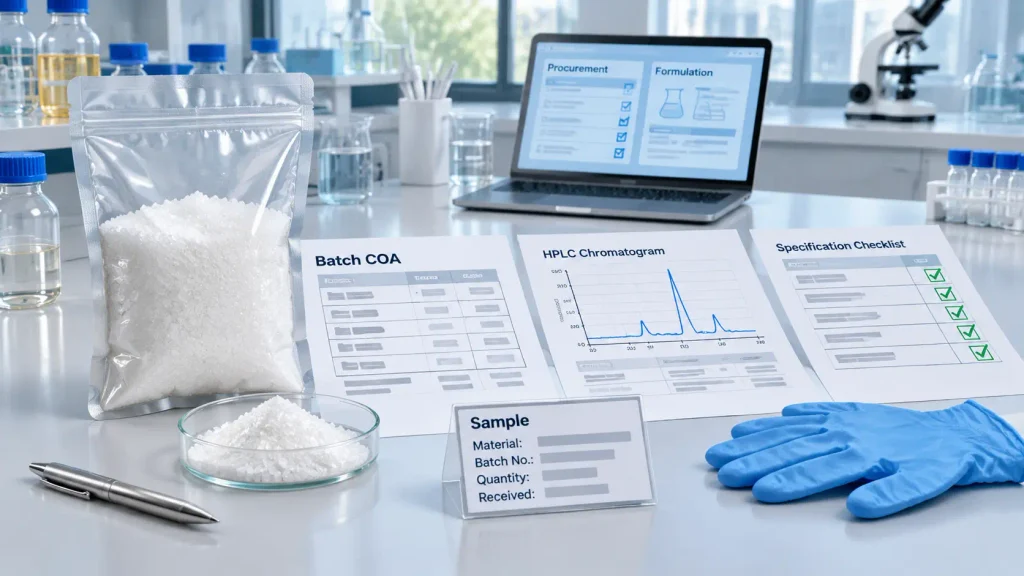
Start by confirming what is actually being offered
Hexamidine Diisethionate has a defined INCI name and CAS number, yet quotations can still become muddled when a trader, repacker, or manufacturer uses a short name. Put the full material name, CAS 659-40-5, intended cosmetic use, requested grade, and target market on the enquiry. Ask the supplier to use the same identity on the quotation, specification, COA, SDS, label, and invoice.
This simple check catches more than spelling differences. It helps reveal whether the document set belongs to the same grade and supply chain. A COA with a different material name, an unexplained internal code, or a specification revision that does not match the quotation needs clarification before a sample enters formulation work.
The supply role also matters. A manufacturer, authorized distributor, and independent repacker may each be able to provide acceptable material, but the traceability path is different. The buyer should know who manufactured the batch, who performed or commissioned the tests, and which company will handle a complaint or change notification.
A specification, a sample COA, and a batch COA do different jobs
A product specification states the limits that a conforming batch should meet. It may list appearance, identity, assay, moisture, residue, impurities, metals, and microbiological criteria. It is the agreement framework.
A sample COA reports results for the sample batch. It is useful only when the sample is identified by lot and its relationship to future commercial supply is clear. A polished “typical COA” without a batch number is marketing information, not batch evidence.
The commercial-batch COA belongs to the lot that will be shipped. It should show the batch or lot number, manufacturing or test date where applicable, test items, specifications, actual results, test methods or method references, approval status, and an authorized release. Buyers using BWX for technical documentation and batch qualification can request the current document set before approving a commercial order.
Do not expect every test to show a numerical result. Identity may be reported as conforms, and a microbiological or elemental result may use a reporting limit. Still, “passes” should connect to an agreed specification and method. A result without a limit is hard to evaluate, while a limit without a batch result says nothing about the material being shipped.
Read the identity and assay lines together
An assay answers how much target material the method reports. It does not, by itself, prove that the powder is the correct substance or explain everything else in the remaining percentage.
Identity testing may use chromatographic retention, infrared comparison, or another validated approach appropriate to the grade. The method should be specific enough to distinguish the intended material from a similar salt, starting material, or related compound. If a supplier reports both an identity test and an HPLC assay, ask whether the methods are part of the routine release procedure for every commercial batch.
Assay basis needs attention as well. A result may be reported as-is, on a dried basis, or against another defined basis. Moisture can change the relationship between the weighed powder and the active content. Purchasing, formulation, and quality teams should use the same basis when comparing suppliers or calculating a low use level.
The missing percentage is a quality question
“99% purity” leaves roughly one percent outside the main reported peak, but that remainder is not automatically one known impurity. It may include related substances, water, residual processing solvents, inorganic residue, or other components that the assay method does not measure in the same way.
Ask which related substances the method can detect, whether individual and total impurity limits are set, and how unknown peaks are handled. Published assessments and pharmacopoeial discussions have identified process-related impurities for hexamidine salts, which makes a defined impurity strategy more useful than a single total-purity claim.
Residual-solvent expectations should reflect the manufacturing process and intended market. The supplier does not need to test every solvent imaginable. It should explain which solvents may reasonably remain from production or purification, the applicable limits, and whether testing is routine, periodic, or supported through process validation.
Elemental controls deserve the same practical treatment. Lead, arsenic, cadmium, mercury, or a broader elemental panel may be relevant depending on the buyer’s specification, market, and risk assessment. Ask for the actual method and reporting limit rather than accepting a generic “heavy metals pass” line that cannot be compared with internal requirements.
Moisture and microbiology can affect a low-dose ingredient
Hexamidine Diisethionate is handled as a crystalline powder and should be protected from moisture during storage. Loss on drying or water content can influence weighing, flow, caking, and the relationship between gross powder mass and active content. The buyer should define a limit and confirm whether opened packaging requires a shorter use period or additional handling controls.
Microbiological testing is not interchangeable with preservative efficacy. A raw-material microbial count checks the ingredient as received. Challenge testing evaluates the finished cosmetic under defined conditions. A clean raw-material result cannot prove that a cleanser, wipe, deodorant, or scalp product is adequately preserved after other ingredients and packaging are introduced.
For material used in water-rich personal-care products, buyers commonly review total aerobic count, yeast and mold, and specified organisms according to the grade and market. The exact panel belongs in the approved specification. It should not be inferred from the ingredient’s antimicrobial function.
Make the development sample represent the commercial grade
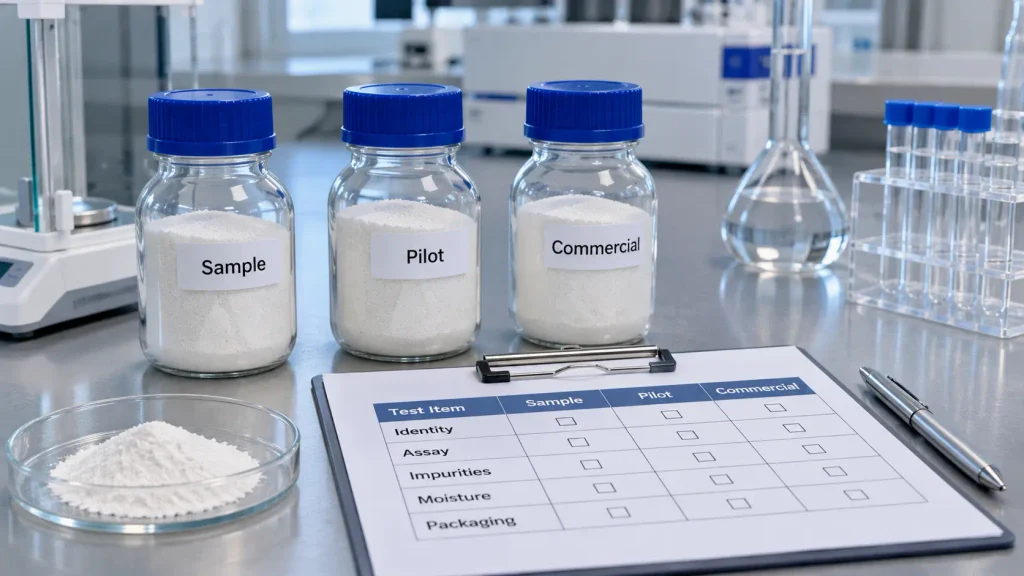
A free sample is helpful only if it answers a commercial question. Record the sample lot, manufacturing source, assay basis, particle or physical description, packaging, and document revision. Ask whether the commercial material will come from the same manufacturing route and quality specification.
Formulation teams should keep the sample’s batch number in the lab record. If the prototype later changes viscosity, color, odor, or preservation performance after scale-up, the team can separate a raw-material change from a process or formula change. For projects evaluating several materials from a cosmetic ingredient portfolio, use one qualification template so identity, assay, impurities, storage, and document status are compared consistently.
Before a first bulk order, request a recent commercial-batch COA or agree that the shipping batch documents must be approved before release. If the commercial batch differs materially from the sampled batch, the buyer may need a confirmation test or a short bench comparison rather than assuming equivalence.
Packaging and change control belong in the approval
BWX standard packaging is 1 kg per bag or 25 kg per drum, with custom packaging available. Select pack size around annual use, weighing controls, and the time an opened container will remain in production. A large drum may lower packaging cost and create repeated-opening exposure for a low-dose ingredient.
Check the inner liner, seal, outer label, lot coding, and transport protection. The receiving team should be able to match the physical package to the COA without interpreting handwritten notes or secondary labels.
Ask how the supplier communicates changes to the manufacturing site, route, specification, test method, packaging, or shelf-life basis. Not every adjustment affects performance, but the buyer needs enough notice to decide whether documents, incoming tests, or formulation work should be updated.
Pre-order qualification checklist
- Confirm full material identity, CAS number, grade, intended use, and target market.
- Approve the current specification before comparing prices.
- Review identity, assay basis, moisture, related substances, residual solvents, elemental controls, and microbiology as applicable.
- Match the sample lot to its COA and record it in formulation work.
- Confirm whether the commercial grade uses the same source, route, and specification.
- Define the required batch documents and the approval point before shipment.
- Agree packaging, storage, opened-container handling, shelf life or retest basis, and change notification.
BWX can provide batch HPLC information and supporting documents including COA, MSDS, and TDS for qualification. A useful enquiry should include the intended cosmetic format, destination market, annual quantity, target pack size, required specification, and any tests that must appear on the commercial-batch COA.
To compare a sample with the available commercial grade, request current Hexamidine batch documents together with the quotation rather than reviewing price first and evidence later.
FAQ
Is a 99% HPLC assay enough to approve Hexamidine Diisethionate?
No. It is an important result, but approval should also cover identity, assay basis, relevant impurities, moisture, documentation, packaging, and any market-specific requirements. The finished cosmetic still needs its own stability, safety, and preservation work.
What is the difference between a specification and a COA?
The specification sets acceptance limits. A COA reports the results for a named batch against those limits. Buyers normally need both documents because one defines the requirement and the other shows how the batch performed.
Should every batch be tested for every possible impurity?
Not necessarily. Testing should follow a risk-based specification tied to the manufacturing process, grade, method capability, and destination market. The supplier should explain which tests are routine and which controls rely on validated processing or periodic verification.
Can a formulation sample be treated as proof of future batch consistency?
No. Keep the sample lot and document set, then confirm that the commercial material follows the same approved source and specification. Significant changes may justify a comparison or additional incoming testing.