Hexamidine diisethionate tends to appear in ingredient lists without much explanation. That can make it look like a simple preservative, yet formulators use it for a wider set of reasons: microbial control, scalp-care support, and the management of formulas intended for blemish-prone or easily unsettled skin.
The important point is that it does not work through one neat, isolated pathway. Its value comes from several related actions, and the finished product still depends on concentration, pH, surfactants, packaging, and preservation testing. A good ingredient choice helps. It does not replace formulation work.

What Is Hexamidine Diisethionate?
Hexamidine diisethionate is the water-compatible salt form of hexamidine, a synthetic dibenzamidine compound. In cosmetic development, it is mainly considered for antimicrobial and preservative functions. BWX supplies Hexamidine Diisethionate as a white to off-white crystalline powder with a stated HPLC purity of at least 99% and CAS number 659-40-5.
The salt form matters in practical formulation. It is readily soluble in water, only slightly soluble in ethanol and other organic solvents, and insoluble in oils. That profile points formulators toward the aqueous phase rather than an oil phase. It also means that a visually clear solution in a beaker is only the first checkpoint; compatibility and stability still need to be confirmed in the complete formula.
How Does Hexamidine Diisethionate Work?
It helps control microbial growth
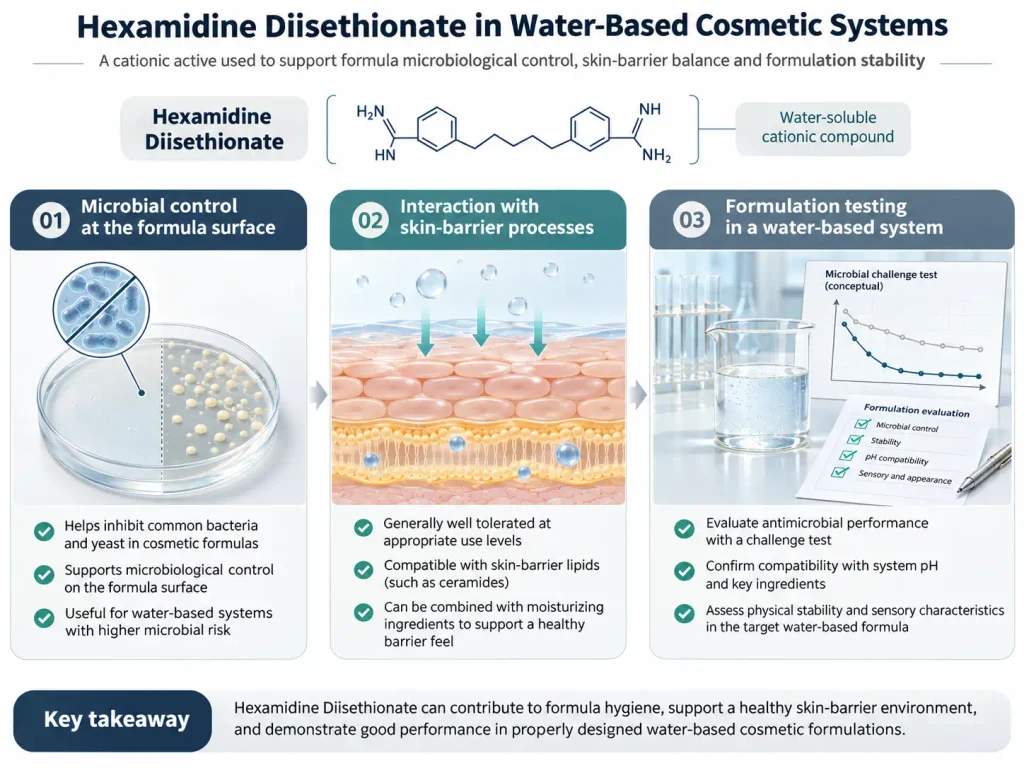
Hexamidine has a long history of use in topical products as a biocidal or preservative ingredient. Its positively charged character supports interaction with negatively charged microbial surfaces. This can disturb functions that microorganisms need to remain viable, which is why the ingredient is considered for control of bacteria and fungi in personal-care products.
That description should not be turned into a promise that one material will preserve every formula. Microbial risk changes with water activity, pH, manufacturing hygiene, packaging, consumer use, and the other ingredients present. A rinse-off cleanser in a pump bottle and a jarred cream repeatedly touched by fingers do not present the same preservation challenge.
It is associated with protease and skin-barrier effects
Published cosmetic-science literature also describes hexamidine as a protease inhibitor and discusses changes in skin-barrier markers, including corneocyte maturity, lipid-processing activity, stratum-corneum thickness, and transepidermal water loss. These findings help explain why the ingredient is sometimes considered for skin-comfort or barrier-focused formulas rather than only for bulk preservation.
The wording needs restraint. Hexamidine diisethionate is not a universal barrier-repair treatment, and a raw-material mechanism does not guarantee a consumer benefit at any concentration. The useful formulation question is narrower: does the complete product show the intended performance, tolerability, and stability in the target use case?
Delivery depends on the vehicle
An ingredient can be active in principle and still perform poorly if the vehicle does not place it where it is needed. Hexamidine diisethionate is hydrophilic, so the emulsion structure, surfactant system, humectants, thickeners, and application time can affect availability at the skin or scalp surface.
This is especially relevant when teams move from a simple laboratory solution to a finished cleanser, serum, shampoo, or emulsion. Solubility, assay recovery, color, odor, viscosity, and antimicrobial performance should all be checked after the formula has been processed and stored under the planned conditions.
Where Is It Used in Skincare and Personal Care?
Facial cleansers and hygiene products
Water-based cleansers are an obvious application because the ingredient can be introduced through the aqueous phase. It may support microbial control while fitting the mild-positioning goals of a facial cleanser, wash, or personal-hygiene product. The surfactant system still needs compatibility testing, particularly when anionic materials are present, because ionic interactions can alter clarity or availability.
Formulators comparing cosmetic and nutraceutical ingredients should treat INCI fit, purity, residual solvents, microbiological limits, and finished-product testing as one decision. A high assay alone does not show whether an ingredient will work in a specific base.
Scalp care and anti-dandruff support
Hexamidine diisethionate is also used in scalp-care and anti-dandruff concepts. Its antimicrobial role can be relevant where control of scalp microorganisms is part of the product strategy. It may appear in shampoos, scalp cleansers, or leave-on scalp products, depending on the regulatory status and the safety assessment for the intended market.
Claims need market-by-market review. “Supports a clean, balanced scalp” and “for dandruff-prone scalps” may fit a cosmetic brief in some regions, while treatment claims can move a product into a drug or therapeutic category. The formula, claim language, evidence, and label must agree.
Blemish-prone skin products
For blemish-prone skin, the ingredient is better framed as antimicrobial support than as an acne cure. It can be considered in cleansers, localized-care products, or lightweight serums where microbial control and skin feel both matter. That still leaves several practical questions: Will it remain compatible with acids or polymers? Does the packaging protect the formula? Is the formula comfortable with repeated use?
A responsible development brief separates cosmetic support from treatment. It also includes a tolerability plan, because even an ingredient described as mild can cause irritation or sensitization in some people.
Sensitive-skin and low-odor formulas
The material is an odorless crystalline powder, which can be useful when a formula must avoid a strong raw-material smell. Its water solubility can also simplify development of clear or low-oil products. Neither property automatically makes a finished product suitable for sensitive skin. Fragrance, surfactants, solvents, pH, preservatives, and contact time all contribute to tolerability.
For a sensitive-skin concept, use the ingredient as one part of a restrained formula, then confirm the result through stability, packaging compatibility, microbiological challenge, and appropriate human safety testing.
Formulation Checks That Should Happen Before Scale-Up
Start with identity and assay, then look beyond the headline specification. For this type of cosmetic active, procurement and quality teams often review individual and total impurities, residual solvents such as toluene and tetrahydrofuran, heavy metals, and microbiological limits. A batch HPLC chromatogram can help connect the delivered lot to the agreed specification.
Next, run formulation-specific work:
- Confirm dissolution in the intended aqueous phase and order of addition.
- Check compatibility with surfactants, polymers, salts, colorants, and other antimicrobial materials.
- Measure pH, viscosity, appearance, odor, and assay through accelerated and real-time stability.
- Run preservative-efficacy or challenge testing on the final formula in its final packaging.
- Review local maximum-use rules, claim boundaries, and label requirements.
- Repeat critical tests after pilot scale-up, because heat history and mixing can change the result.
BWX can provide batch documentation and technical consultation, including COA, MSDS, TDS, and current-batch quality information where available. Buyers should state the intended market and dosage form when requesting documents; that makes it easier to identify gaps before samples enter the laboratory.
What Should Buyers Check When Sourcing Hexamidine Diisethionate?
Begin with the correct identity: Hexamidine Diisethionate, CAS 659-40-5. Then compare the actual specification rather than relying on a product name. Purity method, water content, appearance, solubility, residual-solvent limits, microbial limits, and packaging should be clear before a commercial order.
BWX lists regular packaging as 1 kg per pack or 25 kg per drum, with customized packaging available. For powder exports, the material can be protected with double food-grade polyethylene bags or vacuum aluminum-foil bags inside a fiber drum. Storage should be sealed, cool, dry, and ventilated, away from direct sunlight, high temperature, oxidants, strong acids, and strong bases.
For qualification, request a representative sample and the matching documentation. Test the sample in the real base, not only in water. If the project proceeds, make the purchase specification explicit and confirm which tests will appear on the commercial COA. The most useful supplier conversation is not “Is it good quality?” but “Which measurable limits will define an acceptable batch for this formula and market?”
Final Takeaway
Hexamidine diisethionate works as a multifunctional cosmetic ingredient rather than a single-purpose shortcut. Its antimicrobial action supports microbial control; its reported protease and barrier-related effects help explain interest in scalp, blemish-prone, and skin-comfort applications. Its water solubility also makes it practical for many aqueous personal-care formats.
Successful use still comes down to the finished product. Compatibility, challenge testing, stability, safety assessment, packaging, and claim review cannot be skipped. Formulators and buyers who need a sample, current specification, or document checklist can request Hexamidine Diisethionate sourcing details from BWX and define the required quality limits before scale-up.
FAQ
Is Hexamidine Diisethionate a preservative or a skincare active?
It can serve both roles, depending on the formula and market. It is used for antimicrobial or preservative purposes and is also studied for effects connected with skin homeostasis. The finished formula and permitted claims determine how it should be positioned.
Is Hexamidine Diisethionate water-soluble?
Yes. The BWX specification describes it as readily soluble in water, slightly soluble in ethanol and other organic solvents, and insoluble in oils. Formulators should still verify dissolution and compatibility in the complete base.
Can it treat acne?
It should not be presented as an acne cure. In cosmetic products, a more defensible role is antimicrobial support for blemish-prone skin, subject to local claim rules and finished-product evidence.
Does it replace preservative challenge testing?
No. Ingredient selection does not predict preservation in every formula. The final product should undergo an appropriate microbial challenge or preservative-efficacy test in its intended packaging.
What quality documents should a bulk buyer request?
Common requests include a current COA, specification, MSDS/SDS, TDS, HPLC chromatogram, and relevant statements for residual solvents, heavy metals, and microbiological limits. Requirements should match the destination market and intended application.