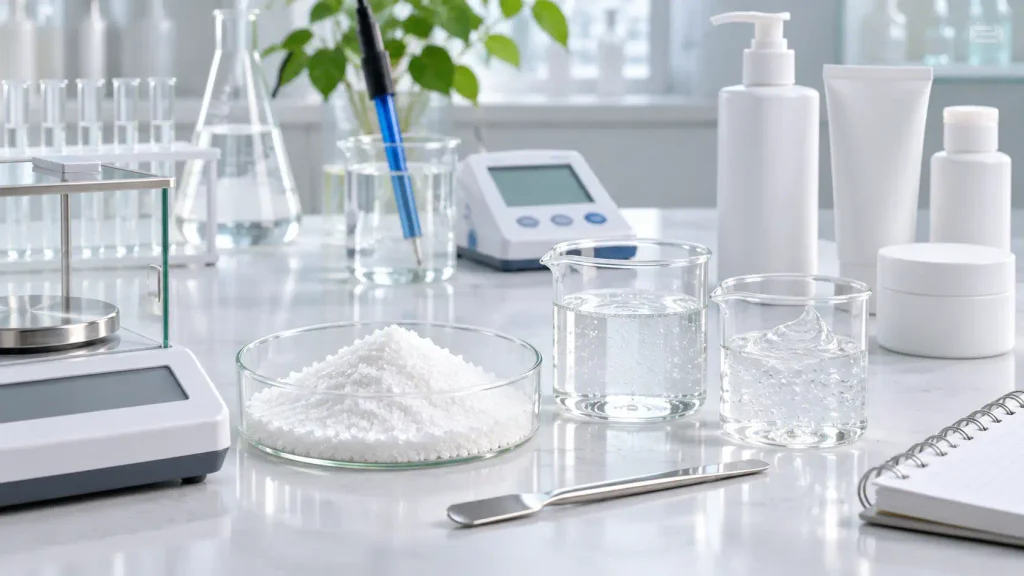
A formula may look gentle on paper, then behave quite differently at the bench: the gel thins overnight, a clear cleanser turns cloudy, or the preservation result changes once fragrance and botanical extracts enter the base. Hexamidine Diisethionate is often considered for mild personal-care products because it dissolves in water and can support antimicrobial control at a low use level. Even so, “Is it safe for sensitive skin?” is too broad a starting question. What matters is whether the chosen dose, base, process and package work together in a stable finished product that passes the tests required for that product.
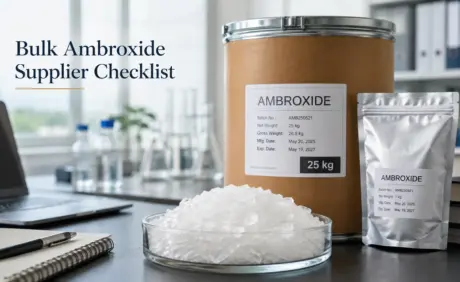
BWX supplies Hexamidine Diisethionate as a white to off-white crystalline powder with HPLC purity of at least 99%. That specification gives formulators a starting point, not a finished-product conclusion. Compatibility, preservation performance and tolerance still have to be demonstrated in the actual formula.
Why formulators consider it for sensitive-skin concepts
Sensitive-skin development rarely comes down to finding one unusually mild ingredient. The brief usually asks for microbial control, a restrained ingredient list, low sting potential and an acceptable after-feel all at once. Improving challenge-test performance by increasing one antimicrobial, for example, may introduce a new sensory or compatibility problem elsewhere in the formula.
Hexamidine Diisethionate is attractive because its diisethionate salt is suited to aqueous processing and has a history of use in personal-care products. Published safety reviews have reported low skin absorption and no irritation or sensitisation in a 0.1% human repeated-insult patch test, while also documenting uncommon cases of contact sensitivity. That combination matters. It supports careful formulation at established cosmetic use levels, but it does not justify “non-allergenic,” “irritation-free” or “safe for everyone” claims.
The ingredient may be evaluated in clarifying cleansers, scalp products, deodorant systems, micellar products, wipes and other water-rich formats. The commercial story should stay cosmetic. Phrases such as “supports a purified-feeling formula” or “helps manage microbial growth in the product” are safer starting points than claims to cure acne, eradicate dandruff or treat an infection. Final wording depends on the market, product format and evidence package.
Solubility helps, but ionic compatibility decides the bench result
Hexamidine Diisethionate is readily soluble in water and only slightly soluble in solvents such as ethanol. That makes it easier to introduce into an aqueous phase than an oil phase. It should not be treated as an oil-soluble active, and a formulator should avoid assuming that a clear concentrate will remain clear after it enters a finished emulsion.
The more important point is charge. Hexamidine is cationic. Anionic polymers, surfactants or other negatively charged ingredients can interact with it, causing loss of viscosity, precipitation or reduced availability. A formula may look acceptable immediately after mixing and separate several days later, particularly after heat cycling or a pH adjustment.
Keep the first compatibility trial deliberately plain. Start with water, the humectant system and the candidate ingredient, then introduce the surfactant, thickener, chelator and fragrance in separate steps. Relevant personal-care ingredient applications may help frame the product format, but the bench sequence still has to reveal which addition changes clarity, viscosity or pH.
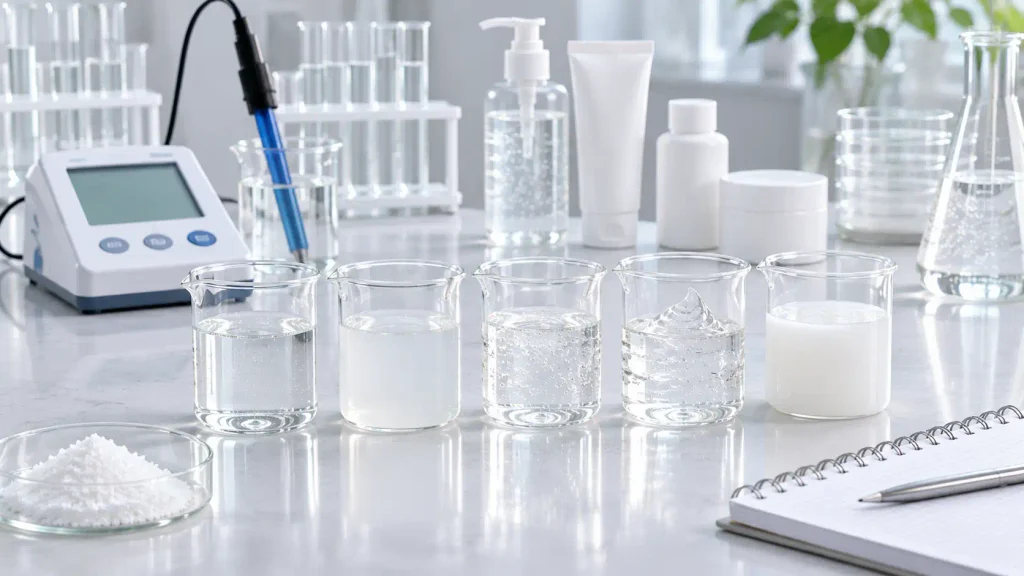
Non-ionic and amphoteric systems are often easier places to begin than heavily anionic bases. If an anionic thickener is essential, compare alternatives rather than forcing one polymer through repeated processing changes. Record appearance, viscosity and pH after each addition. A small compatibility matrix is usually faster than troubleshooting a fully loaded prototype.
A practical development sequence
1. Define the job before choosing the dose
Decide whether the ingredient is being evaluated as part of product preservation, for deodorant support, or for a scalp or blemish-care positioning. These are different formulation jobs. They may require different supporting ingredients, tests and claims.
Set target pH and packaging at the same time. A wipe in a repeatedly opened tub faces a different contamination pattern from a pump cleanser. The test plan should reflect actual consumer use.
2. Prepare a clean aqueous premix
Use controlled water quality and weigh the powder accurately. Add it to the aqueous phase under mixing until the solution is uniform. Avoid using extra heat merely to speed dissolution. BWX lists storage away from high temperature, direct light, moisture, oxidants, strong acids and strong alkalis; good laboratory handling should follow the same logic.
Check the premix before it enters the main vessel. Investigate undissolved particles, unexpected colour or a large pH shift before surfactants, fragrance and packaging trials consume more material.
3. Build complexity in controlled steps
Add the least compatible or most structurally important ingredients separately. In a cleanser, this may mean testing the surfactant blend before the rheology modifier. In a gel, the thickener and neutralisation sequence may be decisive. In an emulsion, compare the ingredient in the water phase with the completed base and watch for delayed instability.
Keep one control without Hexamidine Diisethionate. It helps distinguish an ingredient interaction from a problem already present in the base and gives the microbiology team a challenge-test reference.
4. Test the finished formula, not the ingredient story
Run stability at the temperatures and durations required by the development programme. Include centrifuge or freeze-thaw work when appropriate, along with packaging compatibility. Track colour, odour, viscosity, pH and visible separation. A formula that stays clear in glass may behave differently in a flexible pouch or wipe substrate.
Preservative efficacy or challenge testing must use the final composition. Fragrance, botanical extracts, proteins, clays and some surfactants can change microbial risk or antimicrobial availability. Passing data from a simpler prototype cannot automatically be carried over to the launch formula.
Safety evaluation needs two separate questions
First confirm that the raw material meets agreed identity, purity and impurity requirements. Then assess the finished product under its intended conditions of use. A strong raw-material specification supports that assessment but does not complete it.
For a sensitive-skin product, the assessor should consider concentration, leave-on or rinse-off exposure, application area, frequency, foreseeable misuse and the rest of the formula. Products used near the eye, on mucosal areas, on babies or on compromised skin need category-specific review. Local cosmetic limits and permitted uses must be checked for the destination market.
Human patch-test findings at 0.1% are useful evidence, yet published case reports of contact allergy are a reason to keep claims measured. “Dermatologist tested” also needs an actual study on the finished product. It cannot be inferred from an ingredient monograph or supplier brochure.
What buyers should qualify before scale-up
Ingredient sourcing should follow the same discipline as formulation. Confirm the exact INCI or chemical name, CAS number, assay method, impurity limits, residual-solvent controls, heavy metals and microbiological requirements. For an active used at a low level, small shifts in assay or moisture can complicate dosing and comparisons between batches.
Review the current COA rather than relying on a generic specification. BWX can provide batch HPLC data and supporting documents such as COA, MSDS and TDS for qualification. Ask which analytical method supports the assay and whether it changed between development and commercial supply.
Packaging deserves attention because the material is a hygroscopic-style powder handled in small quantities. Standard packaging is 1 kg per bag or 25 kg per drum, with custom packaging available. Once a bag is opened, the manufacturer should define resealing, storage and retest practice for the plant. Production teams also need a weighing method that limits dust and prevents mix-ups.
When a project uses several cosmetic ingredients, request samples from the intended commercial grade and keep batch numbers in the development record. A prototype built with an untraceable sample creates trouble when the purchasing team later approves a different grade.
A concise formulation checklist
- Define the cosmetic function and permitted claim before selecting a use level.
- Confirm water solubility and screen cationic-anionic interactions in a simple base.
- Compare at least one control formula without the ingredient.
- Check pH, viscosity, clarity, odour and packaging during stability work.
- Run challenge testing on the final composition in its intended package.
- Complete a market-specific safety and regulatory assessment.
- Qualify assay, impurities, residual solvents, metals, microbiology and batch documentation.
Hexamidine Diisethionate can fit a restrained sensitive-skin formula, particularly where water-phase processing and low-dose antimicrobial support are useful. Whether it actually earns a place in the formula depends on the chemistry around it. A short ingredient list, a small but explicit compatibility matrix and finished-product evidence tied to the intended claim will tell the development team far more than the ingredient story alone.
For a sample, specification or current batch document package, discuss a Hexamidine Diisethionate requirement with the product format, target market, annual volume and planned testing information ready.
FAQ
Is Hexamidine Diisethionate suitable for sensitive skin?
It may be suitable at an appropriately assessed cosmetic use level, but suitability must be established in the finished formula. Published data support low irritation at 0.1% under specific test conditions, while rare contact-sensitivity reports mean absolute claims should be avoided.
Is Hexamidine Diisethionate water-soluble?
Yes. The diisethionate salt is readily soluble in water and only slightly soluble in solvents such as ethanol. It should be introduced through the aqueous phase unless formulation work supports another method.
Why can it cause a gel to lose viscosity?
Hexamidine is cationic and may interact with anionic rheology modifiers or other negatively charged ingredients. Test thickeners in a simplified base and monitor delayed viscosity change.
Does it replace preservative efficacy testing?
No. Antimicrobial contribution depends on concentration and the complete formula. The finished product still needs the required preservation, stability, safety and packaging tests.